Truth and Indignation by Ronald Niezen
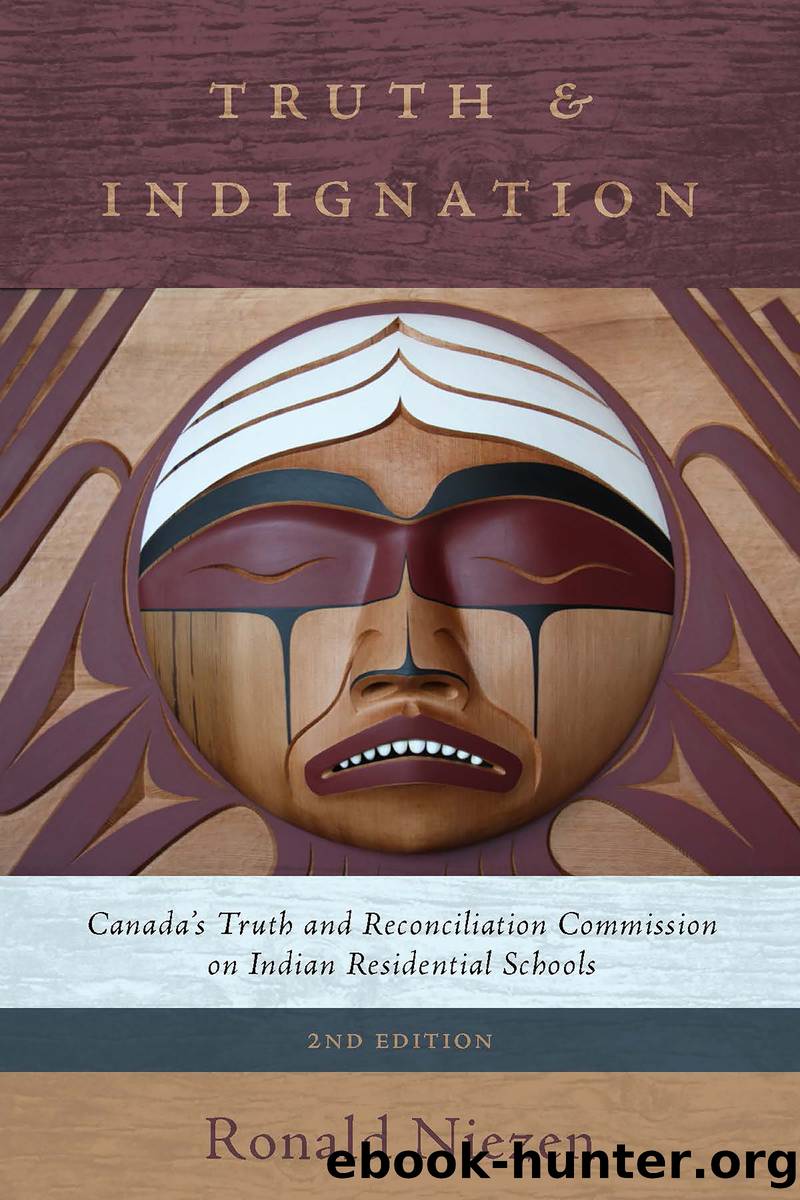
Author:Ronald Niezen
Language: eng
Format: epub
Publisher: University of Toronto Press
At this point, Commissioner Sinclair approached the microphone and called for âhealth supportsâ for the person who was still wailing and weeping loudly enough to be heard across the room. He then made a brief statement in which he argued for Brother Cavanaughâs right to be heard, and he concluded by saying: âWe must ask that you be respectful.â The presentation then continued without further interruption as it fell into the expected pattern. Brother Cavanaugh presented a book about a Catholic-sponsored healing initiative and placed it with hands joined with the commissioner into the bentwood box, and this was followed by handshakes and scattered applause.
The Commissionâs final report recalls this event, and adds that later the same day Ina
Seitcher, who attended the Christie Residential School that Brother Cavanaugh spoke about, gave a very different account of the experience: âThat priest that talked about how loving that Christie residential school wasâit was not. That priest was most likely in his office not knowing what was going on down in the dorms or in the lunchroom.â The Commissionâs report then attributes the absence of such direct exchanges between survivors and former school staff to the fact that, for many, âthe time for reconciliation had not yet arrived.â10
Such interruptions of the pattern, manifested in stress points or ruptures of uncharacteristic emotion, tell us more about the boundaries of testimony than does conformity to them. In this significant moment we have an audience rejecting a narrative truth (âmy experienceâ) that makes a claim to correspondence with a historical truth that wilfully runs against the orthodoxy of survivor experience. It is instructive in the context of this thematic rupture to consider a document that parallels Brother Cavanaughâs argumentâan introduction to a petition, probably written in 1950, addressed to D.M. McKay, then Director of Indian Affairs:
After seeing what is being done in Indian Residential Schools throughout the country, we have come to the conclusion that only a Residential School could be of any utility to us. We therefore hope that you will take into serious consideration the present petition, which has been signed by all the Indians of this Reserve and that you will grant us, in the year 1950, a Residential School large enough to accommodate all our children ... Thanking you in anticipation, we remain, Dear Mr. McKay, Sincerely yours,
The Indians of the Obedjiwan Reserve11
Download
This site does not store any files on its server. We only index and link to content provided by other sites. Please contact the content providers to delete copyright contents if any and email us, we'll remove relevant links or contents immediately.
| Anthropology | Archaeology |
| Philosophy | Politics & Government |
| Social Sciences | Sociology |
| Women's Studies |
Cecilia; Or, Memoirs of an Heiress — Volume 1 by Fanny Burney(32636)
The Great Music City by Andrea Baker(32609)
Cecilia; Or, Memoirs of an Heiress — Volume 2 by Fanny Burney(32010)
Cecilia; Or, Memoirs of an Heiress — Volume 3 by Fanny Burney(31996)
We're Going to Need More Wine by Gabrielle Union(19108)
All the Missing Girls by Megan Miranda(16313)
Pimp by Iceberg Slim(14664)
For the Love of Europe by Rick Steves(14563)
Bombshells: Glamour Girls of a Lifetime by Sullivan Steve(14136)
Norse Mythology by Gaiman Neil(13457)
Talking to Strangers by Malcolm Gladwell(13439)
Fifty Shades Freed by E L James(13289)
Mindhunter: Inside the FBI's Elite Serial Crime Unit by John E. Douglas & Mark Olshaker(9419)
Crazy Rich Asians by Kevin Kwan(9345)
The Lost Art of Listening by Michael P. Nichols(7547)
Enlightenment Now: The Case for Reason, Science, Humanism, and Progress by Steven Pinker(7354)
The Four Agreements by Don Miguel Ruiz(6831)
Bad Blood by John Carreyrou(6669)
Weapons of Math Destruction by Cathy O'Neil(6362)
